From Useful Basket to Regional Craft
Learn how to read a Southern basket through its materials, construction and intended use, and ask better questions at a craft fair or museum.
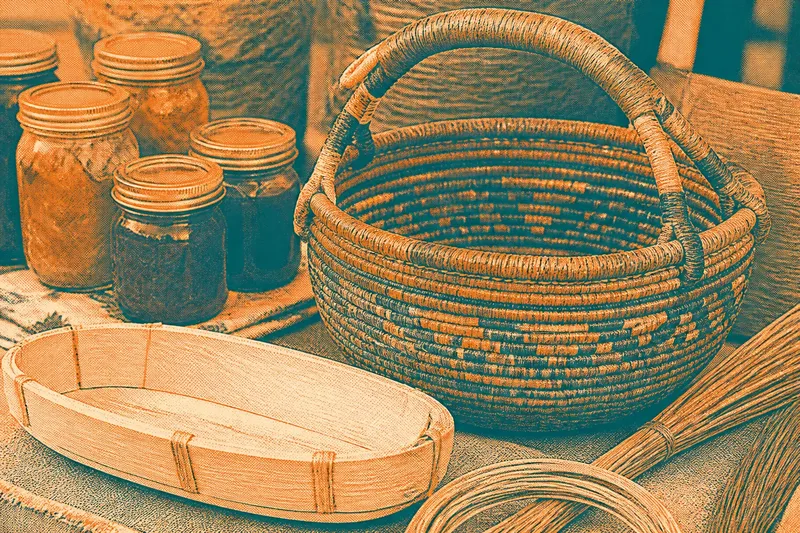
A coiled basket sits beside jars of preserves at a county craft fair, its rim a little uneven and its handle polished by use. A nearby split-ash tray is pale and spare, made for a different task. Southern basketry is not one pattern repeated across a region; each piece reflects its maker’s choices and the work it was meant to do.
What can a basket tell you at first glance?
Start with the shape, not a guess about where it came from. A broad, shallow basket may suit gathering or sorting, while a deeper form can keep loose items contained. A sturdy handle suggests carrying mattered. These are clues, not rules: makers adapt designs, and a basket can acquire a new job long after it leaves the workshop.
Look at how the maker builds the walls. Coiling wraps a pliable material around a growing centre; twining crosses paired elements around upright ribs; plaiting interlaces flat strips over and under one another. These terms describe construction, not a complete identity. Similar techniques appear in different places, and one community may make several forms.
At a fair, ask what the basket was designed to hold or carry. That question often opens a more revealing conversation than asking whether it is “traditional”. A maker may explain how a familiar form has been adjusted for a market stall, a kitchen shelf or a particular material.
How should you think about basket materials?
There is no single material list that represents Southern basketry. A basket may be made with plant material gathered nearby, purchased from a supplier, cultivated, reclaimed or sourced elsewhere. Its material reflects the maker’s knowledge, access and intention; do not infer a community, place or tradition from a plant name alone.
Ask the maker to identify the material and, if they are comfortable sharing, explain how it was sourced and prepared. Names for plants can vary, and a familiar name does not always identify a precise species. If the maker gives a particular community or family context, keep that attribution attached to this basket rather than extending it to others.
Material affects how a basket looks and feels. The way strands bend, cross and meet can make the walls appear rounded, crisp or irregular. Notice where the base becomes the side, how the rim is finished, and whether working strands are tucked, stitched or wrapped. Those details reveal construction without requiring a guess about origin.
A maker may choose purchased or reclaimed material instead of gathering it. That choice is not a measure of the basket’s worth or authenticity. What matters for understanding the piece is what the maker says about its material, purpose and making.
Why does intended use matter?
A basket is easier to understand when you ask what task shaped it. Was it made for carrying produce, holding sewing, storing household goods or presenting food? The intended load and contents influence its size, strength and form. A decorative basket may draw on a useful shape while giving more attention to pattern, display or an exploration of technique.
Say you are a maker planning a basket for a small kitchen garden. You choose a light, flexible material and make the opening broad, so produce can be lifted out without reaching into a deep container. The expected result is an open form with easy access; if the task changes to keeping small tools together, taller sides and a more enclosing weave may suit better.
Baskets can move between jobs. A former market basket may become a display piece; a decorative one may end up holding cloth or post. Ask what the maker intended, then consider whether your own use suits the form. If you are buying a working basket, ask whether its handle, base and finish are suited to the items you plan to carry or store.
What should you ask a maker or curator?
A good question invites detail without asking one person to speak for an entire tradition. At a fair, you might ask about the material, its preparation, the basket’s intended task or the part that required particular care. At a museum, read the object label for the maker, community, material and use; if something is missing, ask staff whether the collection has more information.
- Check whether the maker names the material; if they do, record their wording, and if they are unsure, leave the identification open rather than guessing.
- Check whether the maker describes an intended use; if they do, compare that task with the basket’s shape, and if they do not, describe the shape without assigning a purpose.
- Check whether the rim or handle has a feature the maker explains; if so, note the construction detail, and if not, ask a neutral question rather than treating appearance as proof.
- Check whether a community or family context is offered; if it is, attribute it to this maker or object, and if it is not, avoid supplying one yourself.
- Check whether care instructions are available; if they are, follow the maker’s advice, and if they are not, avoid applying a treatment and ask the maker or a suitable conservator.
- Check whether you have permission before photographing or recording; if you do, proceed within the permission given, and if you do not, keep your notes in writing or ask first.
Listen for the scale of the answer. A maker may speak from personal practice, family knowledge or a particular community tradition; those are meaningful perspectives, not universal claims. If you are taking notes or photographing a piece, ask permission first, especially where a maker is sharing knowledge they consider private.
When buying, ask for a clear description of the material and intended use. If the basket is meant for food, ask whether its finish is suitable for food contact. For a basket intended to carry weight, ask how its handle and base should be used. Follow the maker’s care advice and any product instructions.
How can you care for a basket without overdoing it?
Keep a basket where it will not be crushed or repeatedly knocked against hard edges. Dust it gently with a soft brush or dry cloth, moving with the weave rather than catching the strands. Avoid soaking it or applying oils, polish or household cleaners unless the maker recommends them; treatments can change colour or leave residue.
If a strand loosens, resist the urge to pull it back into place. Tension can shift through the weave, turning a small snag into a larger disturbance. Ask the maker about a repair, or consult a conservator for an old, fragile or culturally significant object. Routine care should preserve what is there, not make a handmade basket look factory-new.
It is not worth trying to identify a basket’s origin from colour or shape alone. Materials can be substituted, designs can travel, and makers bring individual choices to inherited techniques. A precise attribution from the maker or collection is more useful than a confident guess.
Which basket details are worth asking about?
Can one basket stand for Southern basketry?
No single basket can represent the region’s many communities and practices. Treat each piece as a specific object with its own maker and context, and let its story stay particular.
Does a natural material mean the basket was made nearby?
Not necessarily. The material may have been purchased, cultivated, gathered elsewhere or prepared by someone other than the basket maker. Ask directly rather than inferring its source from appearance.
How can I tell whether a basket is for everyday use?
Ask the maker about its intended task, load and care. A strong-looking handle or tight weave can offer clues, but appearance alone cannot tell you how a basket is meant to be used.
What is a useful detail to record after a visit?
Write down the maker or community name when available, the material as identified by the maker, the construction method and the stated purpose. Those details make a better record than a broad label such as “Southern basket”.
What makes a useful field note?
After a craft fair or museum visit, note what you could actually observe: the material as named by the maker or collection, the way the base joins the walls, the shape and the use described. Keep your own interpretation separate from what you were told. That small distinction respects the limits of a quick visit and makes your memory more reliable.
For a basket you bring home, keep the maker’s name and care advice with it. If the piece becomes part of daily life, notice how its form suits that work without assuming your use was the one it was made for. When you encounter another basket, let the maker’s own account guide what you learn about its materials and context.